Saturday, May 11, 2013

Day 15: Zakopane

This morning we walked to the main street to have breakfast. This picture shows how this street, called ul. Krupówki, looks during the day.


This is an example of the typical architecture found in the mountain region. 


After breakfast, we walked towards the mountains, to Biała Dolina (White Valley). Zakopane is also known for its’ ski jumping, and there is a big jump at the base of the mountains.


We entered into the Tatra National Park, and followed a beautiful trail along a stream. 


Kuba had fun playing with the waterproof feature of my camera… these pictures and video are taken underwater!


After spending a couple of hours in the valley, we returned to Zakopane, and caught a bus to Kraków. We had dinner in Kraków before taking our overnight train to Vienna. Stay tuned for our Vienna pictures!

xo

Thursday, May 9, 2013

Day 14: Zakopane and Slovakia (sort of...)

Today we went up into the Tatra mountains by Zakopane. This area is a magnet for outdoor enthusiasts year round with skiing in the winter, and hiking in the summer. There are countless routes among the valleys and mountain tops and it would take a lifetime to see them all. Because we were only here for two and a half days, we opted to take the cable car up to Kasprowy Wierch (Kasprowy Peak) so we could take in the view of the Tatra mountains from the top.


The trip to the top lasted about 10 minutes with a transfer to a second cable car half way up the mountain range. Upon reaching the top, we were 1959 meters above sea level!

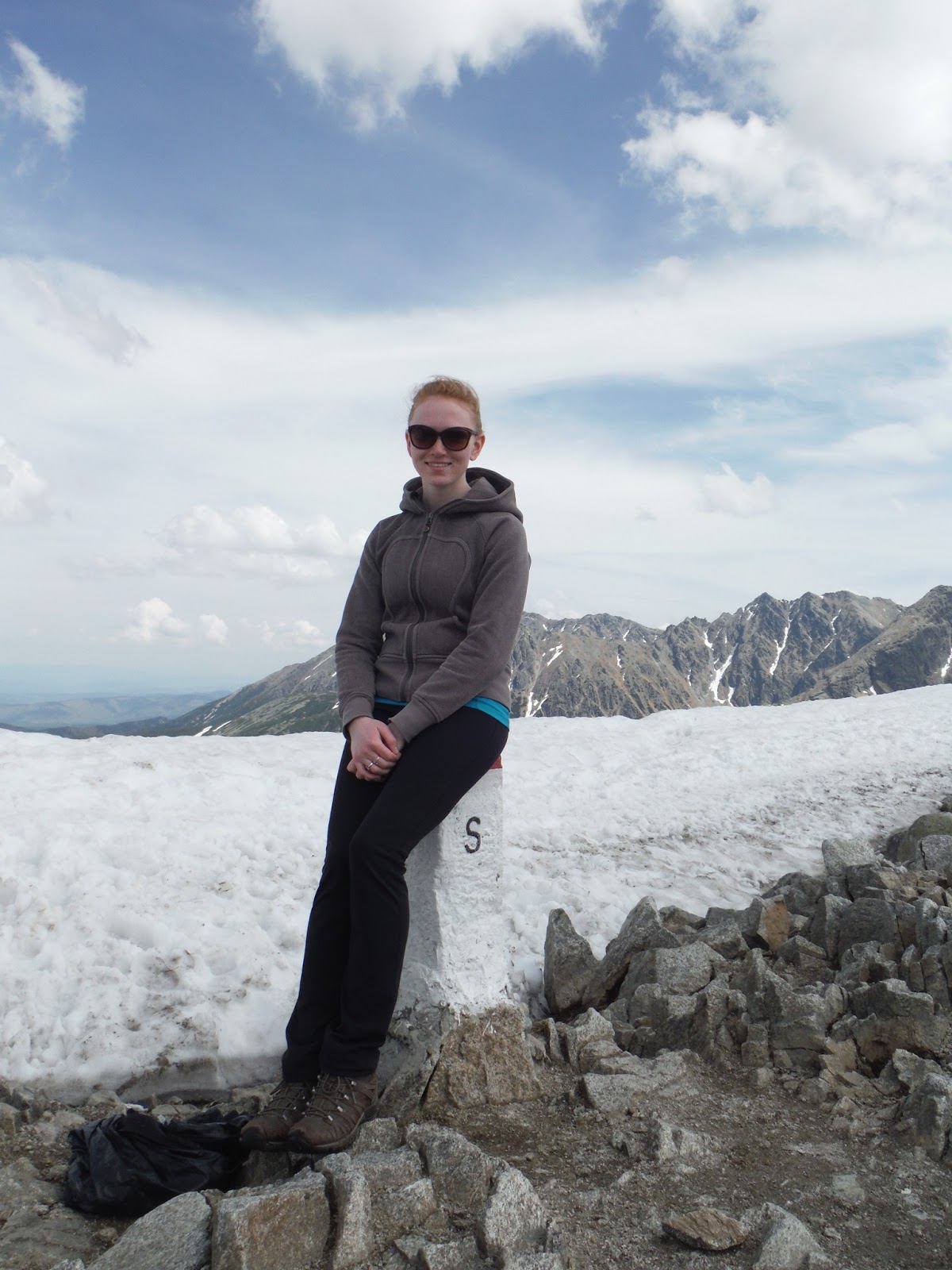
Though it's often windy and cold at the top, today was absolutely gorgeous with the warm sun, and not too much wind. Because it was still pretty early in the season, there were lots of snow caps left, although most were just slush barely deep enough to cover the ground. There are very narrow footpaths that run along the ridges, joining the different peaks. 


The Western Tatras mountain range makes up part of Poland's southern border with Slovakia. Because both countries are in the Schengen zone, the border is nothing more than an uncontrolled series of markers. It's therefore possible to hike back an forth between the two countries to experience both the Polish Tatras and the Slovak Tatras.


Down in the valleys, among the Tatra foothills, you can see the many small towns and villages of southern Poland. Among the largest is Zakopane, where we stayed. The view from the top was amazing, with the snowy mountains and rocky peaks. There isn't much to write about this next set of pictures other than that we couldn't have asked for a better day on top!
 

It's best not to lose one's footing when hiking or climbing the peaks since there is very little by way of protection and it's a looooong way down.


After a few short hours at the top it was time for our cable car ride down.


We returned to Zakopane in the afternoon, and walked around the little village. This is a view of the main pedestrian street at night.

We had dinner at another restaurant that served traditional polish mountain food. Once again, a band of musicians played folk music while we ate.

Tomorrow we leave Zakopane and return to Kraków for a couple of hours, before leaving for Vienna!

xo

Wednesday, May 8, 2013

Day 13: Kraków and Zakopane

Today was a very busy day. This morning we went back to Wawel Hill to visit the Royal Apartments and State Rooms, in the castle. This was the section that was closed on our previous visit. Unfortunately, we were not allowed to take any pictures inside. Below is a panorama taken inside the fortifications, for some reason this photo turned out blue.

Touring the castle took about 3 hours, which included a guided tour of the Royal Apartments, and individual tours of the State Rooms, Treasury, and Armory. The rooms are all restored to different time periods during which the castle was occupied. The seat of the polish kings moved from Kraków to Warsaw in 1596, when the Wawel castle was destroyed by a fire.


This afternoon, we took the bus to Zakopane, which is in the south of Poland, near the Slovakian border, at the base of the Tatry Mountains. Our bus ride took us through the foothills, with many beautiful views such as the one seen below, of a village in a valley.


This was our first view of the mountains!


And this is the view from the balcony of the chalet we’re staying at.


For dinner, we went to a small restaurant on the main street in Zakopane. During dinner there was a group playing traditional highland music… and a very cute little dancer! 


Tuesday, May 7, 2013

Day 12: Kraków and Wieliczka

Today was a very exciting day as we descended into the Wieliczka (Vyeh-lee-ch-ka) salt mine! The mine is located in the small town of Wieliczka, about 10km from Kraków. This salt mine was established in the 13th century and was manned by a continuous line of miners, as jobs were passed from fathers to sons. The main production of table salt stopped in 2007, but small quantities are still harvested from evaporated brine (approximately 15,000 kg a year) making this probably the longest operating company in Poland. Our descent into the mine started with 380 steps down to the first level.

Due to the damp and salty conditions underground, the reinforcing structures had to be made of wood instead of metal. These conditions were great for preserving the wooden supports. Below is a picture of some of the oldest wood in the mine. In this particular case, a flood caused some salt buildup on the wood.

All throughout the mine, the walls and floors are solid rock salt. During the tour we were encouraged to lick the walls to confirm their saltiness...it's true! In some places there are salt formations like these, called cauliflower salt. Salt from the mine was qualified based on its purity, ranging from impure "green salt" to 99.9% pure "eagle salt" which was destined for royal use.

Throughout the mine, there are many scenes depicting legends of Wieliczka. These carvings were made directly into the salt. Older statues were often done by miners, while some carvings are from modern artists. All the grey stone-like material you can see is actually rock salt!

To move the massive quantities of salt harvested from the mine, there were many wood and rope-based winch systems. The earliest ones were man-powered, while later the winches were powered by horses, who stayed down in the mine for 20 years at a time :(

These carvings show gnomes working away in the mines. As legend has it, the gnomes worked through the nights, finishing the jobs of lazy miners.

This is the largest and most beautiful chapel in the mine, the Chapel of St. Kinga. Kinga is the local patron saint of polish miners. The majority of the carvings in the chapel were done by three miners over the course of many years and depict various religious scenes. The miners were very religious workers and would pray before work each day. One interesting feature of the chapel is that the tiled floor is actuially just the underlying salt floor with tile shapes carved into it. This detailed work took over a year to complete. The chandeliers hanging in the chapel, like those throughout the mine, are made of "eagle salt", the purest kind of salt.


This is the second tallest chamber in the mine (31m). The size is breathtaking, as is the wooden support structure. The wood was often painted white because it offered some fire protection, and was better at reflecting light from the small lanterns. By the end of the tour we had reached the third level of the mine (135m below ground) which is as deep as tourists can visit. The whole tour led us through only 1% of this enormous mine. We returned to the top via elevator.

This is a souvenir photo taken by a camera in the mines...


Back in Kraków, we returned to Hogwarts the Collegium Maius, to visit the old college museum. Students and professors in Copernicus' time would live at the college and shared meals twice a day in the dining hall.

The museum consisted of the library, the dining hall, several apartments, the treasuries, and the Copernicus room. In the library we saw some old furniture and implements, such as this reading wheel and the Copernicus astrolabe.

On the left is a view of the library, with the sky painted on the ceiling so the scholars never had to go outside (just an assumption of ours...). This is a cool looking spiral staircase in the dining hall.

The treasury and Copernicus room had some interesting pieces, like this anatomical model and another one of Copernicus' astrolabes, which were either donated to the University, or belonged to previous inhabitants. Among the treasures were a Nobel prize, an Oscar, and an Olympic gold medal from Athens 2004.


As we were leaving the museum, we caught the end of the courtyard clock chiming a melody.